Leave Your Message
Climbing roses can turn a bare fence or sunny wall into a living feature, but they need more than good soil and regular watering. Long canes must be guided, tied, and supported as they grow. A well-chosen Rose Bush Climbing Frame gives those stems room to spread while helping keep flowers visible and airflow moving through the plant. That matters. A flimsy frame may lean under mature growth, while an oversized structure can overwhelm a small border.
Interest in home gardening is broad. The National Gardening Association’s 2024 National Gardening Survey reported that about 80% of U.S. households took part in lawn and garden activities in 2023. The survey covers gardening overall, not rose supports specifically, so it cannot tell us which frame works best. Still, it shows why practical, attractive garden structures matter to many home growers. Not every frame fits. Before choosing, consider the rose’s mature size, available ground space, material durability, anchoring, and how easily you can tie in new shoots. A narrow metal obelisk may suit a compact patio; a broad arch may better support vigorous climbers across a path. Product photos rarely reveal stability in wind or the effort needed to assemble a frame. The options below compare seven popular styles, with attention to those real-world details. Use them as a starting point, then match the frame to your plant, climate, and garden layout.
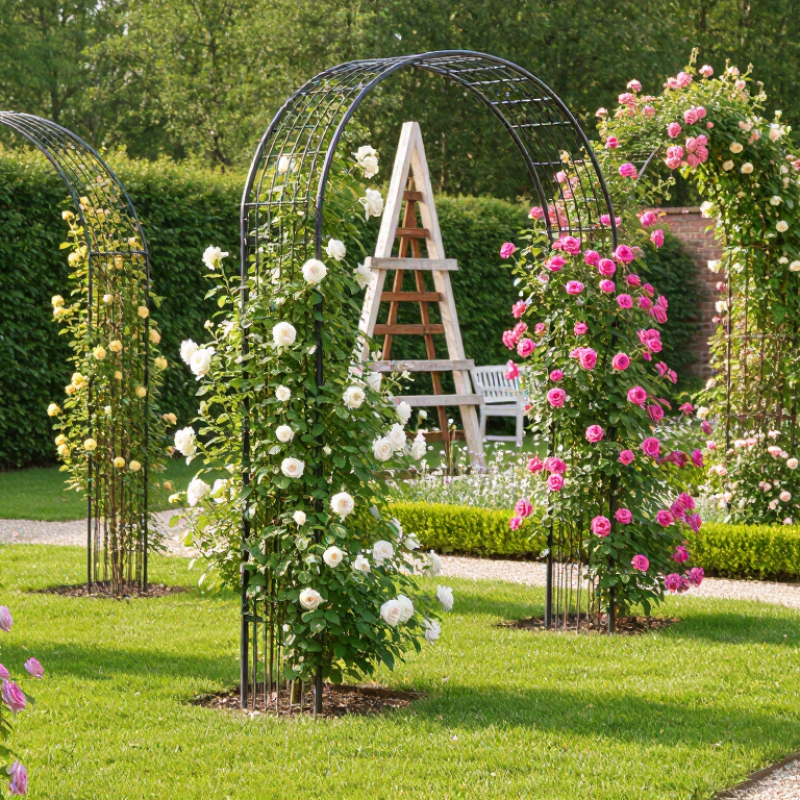
A climbing frame gives rose canes a stable route upward and keeps leaves spaced for better airflow. The Royal Horticultural Society advises planting climbing roses at least 30 cm from a wall, where roots can access rain and soil rather than drying in the wall’s rain shadow. Set the frame far enough forward to leave room for tying and pruning. A narrow trellis can work for a young plant, but established canes need stronger posts and secure fixings.
Tie long stems loosely with soft garden ties, guiding them sideways or diagonally across the frame. This slows the rush upward and encourages flowering shoots along more of each cane. Leave small gaps between stems; tightly packed foliage dries slowly after rain. That matters. Check ties each growing season, since stems thicken and can become pinched. For many garden settings, a frame around 1.8–2.4 m tall gives reachable access for routine care, though mature rose size varies by cultivar. Royal Horticultural Society cultivation guidance also stresses training and tying climbers to their support. A frame is not a cure for poor light or unsuitable soil, and I would not expect it to transform a struggling rose overnight. The awkward part is maintenance: loose ties and a quick seasonal check are easy to forget.
These are seven practical frame styles rather than specific branded products. Suggested dimensions are typical planning ranges; choose a size suited to the rose variety, planting site, and available space.
| Frame style | Typical size | Best suited to | How it supports rose growth | Practical considerations |
|---|---|---|---|---|
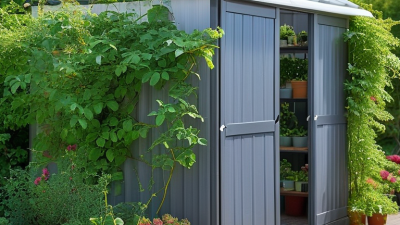
| Wall-mounted trellis | About 1.8–2.4 m high and 0.9–1.8 m wide | Climbing roses beside a wall, fence, or outbuilding | Provides horizontal and vertical points for tying in long canes, helping spread growth across the surface and display flowers more evenly. | Leave a small gap between the trellis and wall for airflow and maintenance. Fix it securely and tie canes loosely with soft garden ties. |
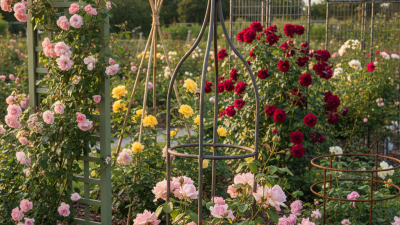
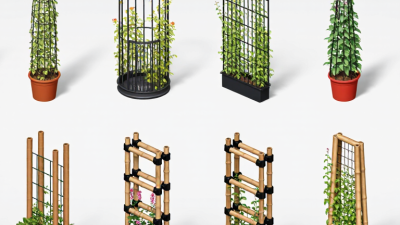
| Freestanding garden obelisk | About 1.5–2.1 m high with a 0.4–0.7 m base | Compact climbing roses in a border or large container | Offers a vertical structure around which flexible canes can be arranged and secured as they grow. | Choose a stable base and allow room around the plant. A large, vigorous rose may outgrow a small obelisk. |
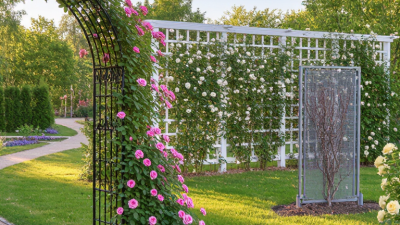
| Rose arch | About 2.1–2.5 m high and 1.2–1.5 m wide | Pathways, garden entrances, or a focal point between beds | Supports canes trained up the sides and along the curved top, creating an overhead flower display as growth matures. | Anchor the legs firmly. Train canes gradually and avoid overcrowding the arch or blocking the walking space. |
| Horizontal wire system | Wires commonly spaced about 30–45 cm apart | Long walls and fences where a low-profile support is preferred | Lets gardeners tie long canes in a fan or near-horizontal position, encouraging flowering shoots along more of the cane. | Use weather-resistant wire with secure wall fixings. Keep ties loose enough to accommodate cane growth. |
| Fan-shaped wall frame | About 1.5–2.1 m high and 1.2–1.8 m wide | Training a rose across a broad, flat wall or fence area | Guides main canes outward from the base, helping distribute foliage and flowers over a wider area. | Plan the frame around the mature spread of the rose. Prune and tie in new growth to maintain an open, balanced shape. |
| Freestanding panel trellis | About 1.5–2.1 m high and 0.9–1.8 m wide | Dividing garden areas or supporting roses away from a wall | Creates a two-sided support surface, allowing canes to be positioned and tied at several heights. | Secure the panel against wind and keep it accessible from at least one side for pruning and tying. |
| Large pergola or overhead framework | Often 2.2–2.7 m high; span varies with the garden layout | Vigorous climbing roses with long canes and ample growing space | Supports mature canes across beams, creating a broad canopy of foliage and flowers when trained over time. | Use a strong, well-anchored structure designed for outdoor loads. Allow space for air circulation and safe access for pruning. |