
For global buyers, choosing a China-based rose plant support supplier involves more than comparing prices. The right Rose Plant Support should help stems grow upright without squeezing new shoots or damaging delicate canes. In a garden, small details matter: a rough wire edge can snag leaves, while a narrow ring may crowd a mature plant. Details matter.
Reliable sourcing begins with clear product information. Buyers should check support height, ring diameter, material thickness, finish, and packaging before placing an order. Steel supports may offer useful strength, while a protective coating can help reduce surface rust during ordinary outdoor use. Still, performance depends on climate, installation, and care. A supplier should explain these limits plainly, rather than promise that one product suits every garden.
Samples and practical questions can reveal more than a polished catalog image. Ask how products are inspected, how dimensions are measured, and whether custom sizes affect lead times or packing. Requesting photos of finished goods and reviewing packaging details can also help prevent avoidable surprises during transport. A support that looks sturdy on a screen may feel too heavy, short, or awkward beside an actual rose bush. That is worth considering.
This guide explores what global buyers can assess when comparing suppliers in China, from product design and quality communication to customization and export readiness. No supplier or support design is perfect for every market. The useful choice is the one whose specifications fit the garden, whose claims can be checked, and whose team responds clearly when something needs a second look.
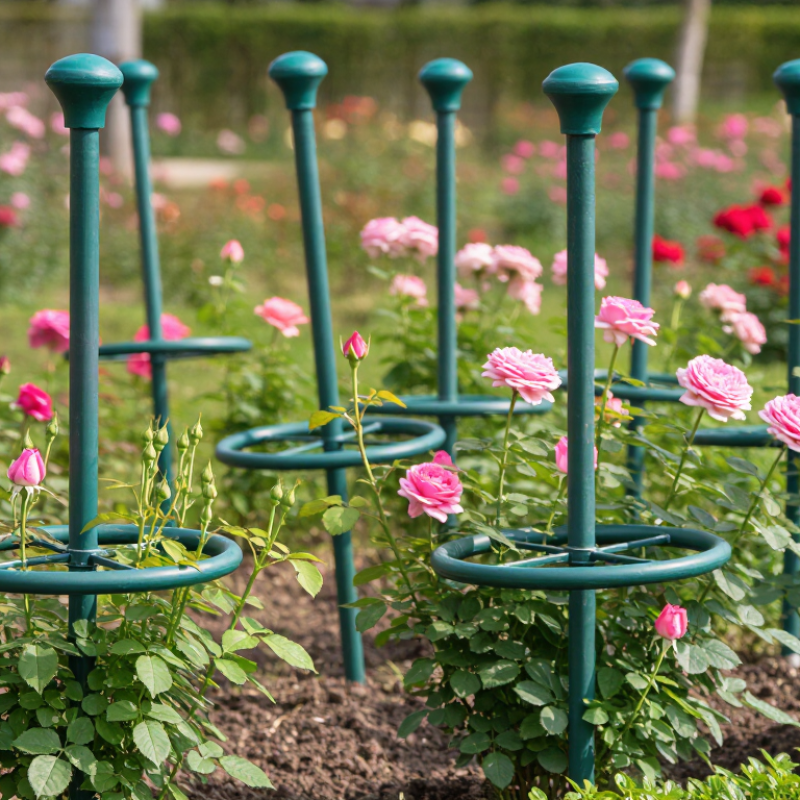
Rose plant supports are frames, stakes, rings, or trellises that guide stems as they grow. Climbing roses often need a sturdy trellis or post, while compact bushes may benefit from a simple ring. The right support depends on the plant’s size, growth habit, and location. That matters.
Supports help keep long canes from sprawling across paths or bending under heavy blooms. They can also create more space between stems, allowing air to move through the plant. This may help foliage dry sooner after rain, though a support cannot prevent every plant problem. Not a cure.
Set the support in place before the rose becomes large; pushing stakes through established roots can cause damage. Tie canes loosely with soft garden ties, leaving room for stems to thicken. Guide flexible young growth along a trellis rather than forcing older, woody canes into position. Check ties after windy weather and loosen any that dig into the bark. A support can look awkward at first, and it may need adjusting as the rose grows. That is normal.

Rose supports commonly use galvanized steel, powder-coated steel, treated wood, bamboo, or weather-resistant polymers. Each suits a different garden. Steel offers a slim profile and strong load capacity, while bamboo feels lighter and blends into borders. The World Steel Association reported 1,892.2 million tonnes of crude steel production worldwide in 2023 in World Steel in Figures 2024. That scale signals a broad supply base, not a guarantee of consistent coating quality. Buyers should check wire thickness, weld finish, and coating coverage. Small gaps can rust early.
Design matters as much as material. Ring supports help contain spreading bushes; grids and open frames guide upright growth while leaving room for pruning. For long stems, use adjustable ties that hold without cutting into the bark. Wood and bamboo can look warm, but moisture and soil contact may shorten their service life. Plastic-coated wire is easy to handle, though damaged coating can expose the core. No material is perfect. Ask suppliers for load details, dimensions, and outdoor-use specifications, then test one sample through a wet season before placing a large order.
Assess a Chinese rose-support supplier through product specifications, factory controls, and communication—not catalog photos alone. Ask for the steel grade, wire diameter, coating type, coating thickness, and height tolerance. For welded trellises, inspect joints for sharp edges, uneven welds, and movement under pressure. Looks matter less.
Request samples from the same production process used for bulk orders. Measure several pieces, check coating consistency, and leave them outdoors to observe early rust or fading. A sample can still mislead; it may not represent a full production run. Ask for batch records, inspection criteria, and clear procedures for handling defects. Confirm packaging details too, since bent supports can arrive after long-distance shipping.
Market scale offers context, not a quality guarantee. The USDA National Agricultural Statistics Service’s 2023 Floriculture Crops report valued U.S. floriculture sales at about $6.7 billion. Buyers should still verify each supplier’s claims with documented test results and recent production references. Discuss order capacity, lead times, and whether material substitutions require approval. Vague answers are a warning. A detailed quotation should state dimensions, finish, packing method, inspection terms, and delivery schedule.
Global buyers assessing a rose plant support supplier in China should look beyond catalogue photos. Ask for written specifications covering wire diameter, support height, joint construction, and coating type. These details affect stability in damp soil and repeated outdoor use. Small details matter. A reliable manufacturer should keep material records and link production batches to inspection results.
Quality control can include checking dimensions, welds, sharp edges, coating coverage, and packaging before shipment. For coated steel supports, inspect for bare spots and uneven finishes, especially near joints and cut ends. Request test methods and sample records rather than accepting a general claim of “high quality.” Paperwork matters. Buyers can also approve a pre-production sample and compare random finished pieces against it. Then test again.
Load performance depends on plant size, soil, wind, and installation, so one rating may not suit every garden. Ask how the support was tested and under what conditions. A checklist helps, but it cannot catch every defect; this is where a third-party inspection may be useful. Even careful factories can miss a bent stem or a poorly packed bundle. Reviewing real samples and correcting the specification early can prevent avoidable problems later.
| Manufacturing Stage | Quality-Control Dimension | Inspection Method or Reference | Buyer-Agreed Acceptance Criteria | Quality Record |
|---|---|---|---|---|
| Quality management | Documented production controls, inspection responsibilities, and corrective actions | Review the supplier’s quality-management documentation. ISO 9001 is a quality-management system standard; certification should be verified if claimed. | Agree on approved drawings, specifications, inspection stages, and a process for recording and resolving nonconformities. | Quality plan, inspection procedures, and corrective-action records |
| Incoming materials | Material type, dimensions, and surface condition of wire, tube, rod, or molded components | Check purchase documentation and material identification; measure samples with suitable calibrated instruments. | Materials and dimensions match the approved specification; no damage or visible defects that affect assembly or intended use. | Material certificates where specified, receiving-inspection results, and supplier batch details |
| Forming and fabrication | Overall height, width, stake length, ring or loop position, and shape | Compare samples with the approved drawing using a ruler, tape measure, caliper, or suitable fixture. | Dimensions and tolerances follow the buyer-approved drawing. Tolerances should be defined for each product rather than assumed to be universal. | First-article inspection and in-process measurement records |
| Welding and joining | Joint integrity, alignment, and sharp edges or projections | Visual inspection and, where appropriate, a buyer-agreed functional or load test on representative samples. | Joints remain intact during the agreed test; parts are aligned as specified and have no hazardous burrs or sharp projections. | Weld or joint inspection results and sample test records |
| Coating and corrosion protection | Coating coverage, thickness, adhesion, and visible finish | Visual inspection; coating thickness may be measured using ISO 2178 for suitable magnetic substrates. Adhesion may be assessed using an agreed method such as ISO 2409 or ASTM D3359. | Coating type, target thickness, appearance, and adhesion rating must be agreed in the product specification. Test methods do not set a universal pass limit for every product. | Coating inspection results, instrument checks, and finish specification |
| Corrosion testing | Resistance to corrosion under specified test conditions | Salt-spray testing may be conducted using ISO 9227 when requested; the exposure duration and evaluation criteria must be agreed before testing. | Pass/fail criteria should reflect the intended material, finish, environment, and buyer requirements. Salt-spray results do not directly predict service life. | Laboratory report identifying the test method, conditions, duration, and results |
| Finished-product inspection | Assembly, stability, function, labeling, and workmanship | Inspect finished samples against the approved specification and perform agreed fit, stability, or functional checks. | Product matches the approved sample and specification; no defects that prevent intended assembly, handling, or use. | Final inspection checklist and approved sample reference |
| Sampling and shipment release | Lot acceptance, quantity, packaging, and shipment identification | Use a sampling plan agreed with the buyer. ISO 2859-1 provides sampling procedures for inspection by attributes; select the inspection level and acceptance limits in advance. | Release only when inspection results meet the agreed sampling plan and the order’s packaging, marking, and quantity requirements. | Final inspection report, packing list, and shipment traceability records |
| Inspection limits, test loads, coating requirements, sampling levels, and acceptance criteria are product- and buyer-specific. Agree and document them before production; the standards listed above describe management systems, sampling, or test methods and do not automatically establish product-specific pass/fail limits. | ||||
A dependable rose plant support order begins with a clear specification. Buyers should confirm stake height, wire thickness, coating, bundle size, and packaging before requesting a quotation. For custom orders, share a simple drawing and the rose varieties or growing conditions involved. A support designed for a small garden bed may not suit a commercial greenhouse. Ask for a pre-production sample when dimensions or finishes are new. Small details matter.
Shipping plans deserve equal attention. UNCTAD’s Review of Maritime Transport 2024 reported that global maritime trade grew 2.4% in 2023, with 2% growth forecast for 2024. Freight conditions can still shift, so request separate quotes for production, inland transport, and ocean or air freight. The World Bank’s 2023 Logistics Performance Index assessed 139 economies across six areas, including customs, shipment tracking, and timeliness. These measures offer a useful reminder: a low product price is not the whole landed cost. Confirm carton dimensions, pallet limits, shipping marks, lead time, and destination delivery terms with your supplier. One easy-to-miss issue is whether bundled supports fit the receiving warehouse’s handling equipment.
Tips: Send your preferred delivery window and target port with the first inquiry. Ask for photos of packed goods, not only finished supports. Leave a buffer for delays; estimates are not guarantees.